
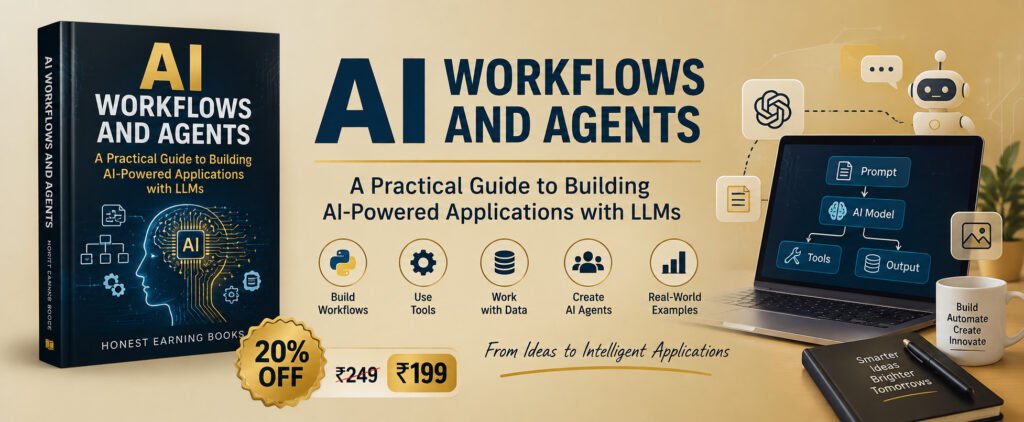
Learn how modern AI applications are built from the ground up with AI Workflows and Agents — a practical guide to building AI-powered workflows, applications, and autonomous agents with Large Language Models. This book takes you beyond the idea of “AI magic” and explains how models, APIs, tools, memory, and control flow work together.
What You’ll Learn
- Understand the difference between AI workflows and AI agents
- Learn how Large Language Models work inside real applications
- Build AI workflows using Python and model APIs
- Set up a practical development environment for AI projects
- Write effective prompts and use few-shot examples
- Build multi-step AI workflows for real-world tasks
- Choose AI models based on task difficulty, cost, and performance
- Run open-weight AI models locally using Ollama
- Work with structured outputs and JSON schemas
- Use Pydantic for structured data handling
- Handle API errors, retries, timeouts, and model failures
- Build workflows involving images, files, and multiple outputs
- Manage sequential, parallel, conditional, and repeated workflow steps
- Add human-in-the-loop approval and feedback checkpoints
- Connect AI workflows to third-party services and APIs
- Understand Retrieval-Augmented Generation (RAG)
- Learn how AI agents use tools and function calling
- Build specialized and general-purpose AI agents
- Understand multi-agent systems and agent collaboration
- Manage short-term and long-term memory in AI systems
- Test and evaluate AI workflows and agents
- Explore agent frameworks such as CrewAI
Why This Book?
AI development can quickly become confusing. There are countless models, frameworks, APIs, tools, and new concepts appearing every day. AI Workflows and Agents takes a practical approach by focusing on the core building blocks that help you understand how modern AI applications are designed and developed.
Instead of treating AI systems as black boxes, this book explains how workflows and agents operate and how models, tools, memory, retrieval, and control flow can be combined to create useful AI-powered applications.
AI Workflows vs. AI Agents
One of the key concepts covered in the book is understanding when to use a workflow and when an agent makes more sense.
AI Workflow
A workflow follows a defined sequence of steps. It provides greater control and predictability and works well when the process can be clearly planned in advance.
AI Agent
An agent can determine which tools to use and what actions to take at runtime. This flexibility is useful for tasks where the exact path cannot always be defined in advance.
From Your First Workflow to AI Agents
The book begins with the fundamentals and gradually moves toward more advanced AI systems. You’ll start with model APIs and simple workflows, then progress to prompt engineering, multi-step workflows, structured outputs, reliability, third-party integrations, and retrieval-augmented generation.
The later sections introduce AI agents, tool use, function calling, specialized agents, multi-agent systems, memory, testing, evaluation, and agent frameworks.
Key Topics Covered
Learn how clear instructions, examples, and structured prompts can improve AI outputs.
Combine multiple AI and non-AI operations into practical workflows.
Work with predictable data structures, JSON schemas, and typed outputs.
Understand how retrieval can provide AI models with relevant information from external documents and data.
Learn how agents can use tools and function calling to perform tasks.
Explore how multiple specialized agents can collaborate within a larger AI system.
“Understand what is happening behind the scenes — then build it yourself.”
Who Is This Book For?
- Developers who want to build AI-powered applications
- Python programmers beginning with LLM development
- AI enthusiasts who want to understand workflows and agents
- Students learning practical AI application development
- Developers exploring RAG, tool use, and function calling
- Builders interested in AI automation and workflows
- Anyone who wants to understand how AI agents work beyond a chatbot interface
What You’ll Build
Throughout the book, practical examples demonstrate how individual components can be combined into useful AI systems. You’ll explore examples involving content generation, multi-step processing, structured information extraction, external services, retrieval, tool use, and agent-based systems.
The goal is not simply to copy a particular framework. By understanding the underlying concepts, you can adapt these ideas to different models, APIs, programming languages, and AI projects.
Explore the Book
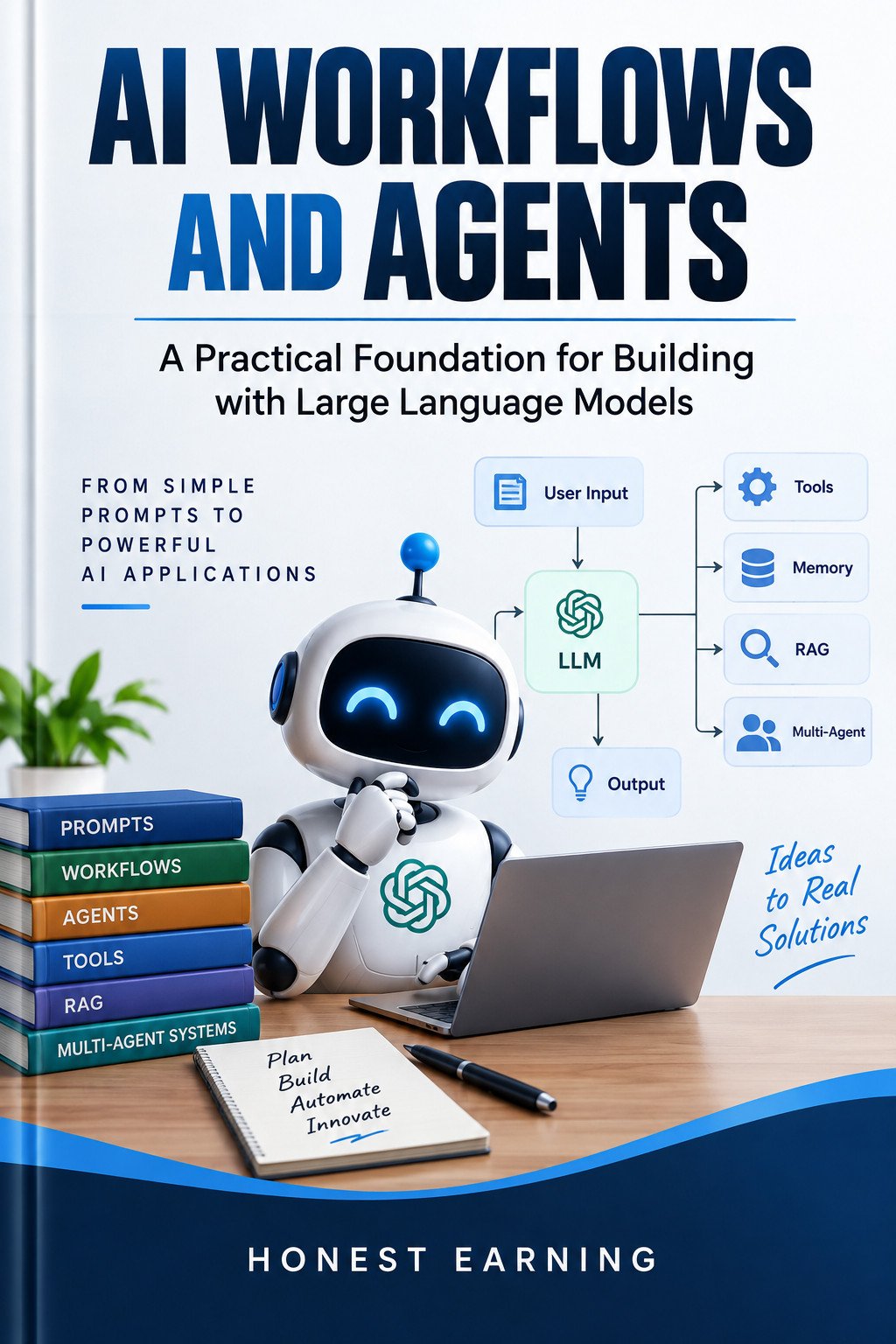
Get 20% Off AI Workflows and Agents
Join our reader list and we’ll send you a discount code for this book, plus updates when we publish new titles.
Leave a Reply